
At this lovely time of year when the leaves are changing colors and falling to earth, when the temperatures have cooled down considerably, and as we approach our more than one month long “holiday season”, let’s pause to consider what an attitude of thankfulness really means.
Throughout the Word of God, we are instructed to “give thanks” to the Lord literally hundreds of times! And yet, we often hurriedly read these passages, particularly in the Psalms, and fail to consider what this actually means in the life of a believer in Christ. Do we, perhaps, take for granted the admonition, rather haphazardly bowing our heads at meals to say grace, and forgetting that true thankfulness to God is an attitude that should permeate everything we do in life? Do we neglect this continual state of true thanksgiving to God and instead insert the negative emotions that come through daily living, substituting them for the gratefulness we owe our Heavenly Father?
Question:
Why do you suppose God desires that His children worship, praise, honor and thank Him on a daily basis for all of His many blessings to them? Couldn’t He have just created people who were automatically programmed, such as robots, to be thankful without being asked to do so? I have thought about this many times, wondering why Jesus said in Luke 19:40 that if the people who were rejoicing and praising God with a loud voice were to hold their peace, “the stones would immediately cry out.” He knew in all of His infinite wisdom that if His Father created men and women who were given a free will as to whether or not they would worship God with thankful hearts, the very act of doing so would be much more beneficial to them, not to mention that it would delight the heart of God! That is why instead of creating stones and inanimate objects to worship Him, He gave human beings a choice in the matter. When they engage in thankfulness, worship and praise, God is pleased, and the end result is that His blessings are poured out upon them in tangible ways, including spiritually, emotionally, physically and materially. He actually “lives in our praises” as Psalm 22:3 reads, “But thou art holy, O thou that inhabits the praises of Israel.” (KJV) To inhabit means to “live in” so when we praise or give thanks to the Lord, He actually is living in those praises! I find that very exciting.
If I want to know God’s perfect will for my life, be the recipient of His blessings, and walk in peace and joy every day, what better way to accomplish this than to have Him living in my praises? The act of ministering to God with words and songs of thanksgiving, praise and worship delight Him and cause His blessings to be poured out in abundance! I love the Doxology hymn whose first line says, “Praise God from whom all blessings flow!” That really says it all!
When you give your child a lovely gift, perhaps something they have asked for repeatedly and longed for, isn’t your heart blessed when they say, “Oh, thank you so much for this wonderful gift, Mommy!” or “I am so happy that you were able to get this gift for me, Daddy! I will always treasure it!” What if they just opened it and said nothing, perhaps running out of the room to play with it and never said a word of thanks? Wouldn’t your heart be grieved? I believe Jesus felt the same way when He healed ten lepers and only one of the ten returned to glorify God with a loud voice, falling down on his face at Jesus’ feet and giving him thanks (Luke 17:11-18). Jesus said in verses 17 and 18, “Were there not ten cleansed? But the nine—where are they? Was no one found who returned to give glory to God, except this foreigner?” (NASB) He happened to be a Samaritan; the men healed who lived in the village near Galilee apparently did not think it necessary to return and thank Jesus. Are we often guilty of this? Do we continually cry out to the Lord with our needs, grievances, hurts, pain and suffering, while neglecting to thank Him for the many things He has done for us, and especially giving thanks when He intervenes and answers our prayers?
So, during this Thanksgiving season let us remember to give thanks first and foremost to the One who gave His life for us that we might have Eternal life and who truly does give us all things to enjoy! Here is a verse that really sums up the whole matter, where Paul is writing to Timothy: “Instruct those who are rich in this present world not to be conceited or to set their hope on the uncertainty of riches, but on God, who richly supplies us with all things to enjoy.” (I Timothy 6:17, NASB) I hope you will have a wonderful Thanksgiving with your family and loved ones and remember to “have an attitude of gratitude” and be truly thankful!
Please join me in praise to God as I play my Thanksgiving medley: “Now Thank We All Our God” and “Come, Ye Thankful People, Come” (This and my other music is available to add to your playlist on Pandora, Spotify, and for purchase on Amazon and Apple Music. See link on right side of this page).

 I posted this ten years ago here on my blog but I think it bears repeating! I hope you will enjoy this:






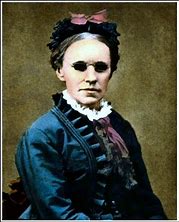 If you have gone to church all of your life (as I have) or if you have only attended a few times for special services or events you, no doubt, have heard some of the following songs sung: “Blessed Assurance”, “Near the Cross”, “To God Be the Glory” or “Pass Me Not, O Gentle Savior“. What do they all have in common? The lyricist to these and nearly 9,000 other Gospel songs and hymns is a woman whose name you may have heard; she was Frances Jane van Alstyne, and she went by her maiden name, Fanny J. Crosby. She is known as the “Queen of Gospel Songwriters” and the “Mother of modern congregational singing in America”, with more than 100 million copies of her songs in print. Perhaps no one has seen more of their songs included in church hymnals than Fanny Crosby. But, what you may not know about her is the fact she was blind from shortly after birth!
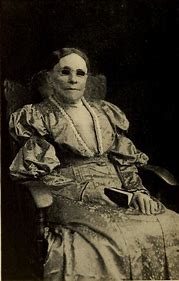 One of my favorite Fanny J. Crosby songs is the well-known hymn, “Praise Him, Praise Him” which I recorded a few years ago in a bit of an up-tempo jazzy version; I hope she would have approved! The melody is composed by Chester G. Allen. I hope you will enjoy my arrangement as we celebrate the life and music of a remarkable woman devoted to God in spite of her challenges, and who was determined to write lyrics that would lift up Jesus and win people to Him! Fanny had set a goal of winning a million people to Christ through her hymns, and whenever she wrote a hymn she prayed it would bring men and women to Christ; she kept careful records of those reported to have been saved through her hymns! I believe that goal has been surpassed many times over throughout the years as people of all ages continue to be blessed, inspired and changed through listening to the words of Fanny J. Crosby set to music!


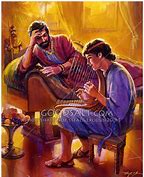 Last time we talked about how King Saul went from being an anointed King of Israel filled with God’s Spirit, to a tormented man troubled by an evil spirit causing him to exhibit disturbing and violent behavior. Let’s pick up the story: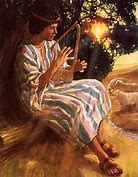

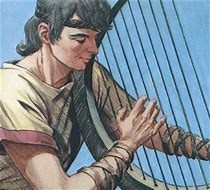 Have you ever read in God’s Word the accounts of how David, a lowly shepherd boy, came before the great King Saul and basically chased away a tormenting evil spirit from him simply by playing skillfully on a harp? Have you ever wondered how he got into this condition, actually hurling weapons at David and acting like a crazy man? Well, it’s quite a story and in order to fully understand it we need to get some background which I Samuel gives us.
 Music Is Worship
You must be logged in to post a comment.